
What Commercial Water Features Reveal About Your Vendor’s Accountability Standards
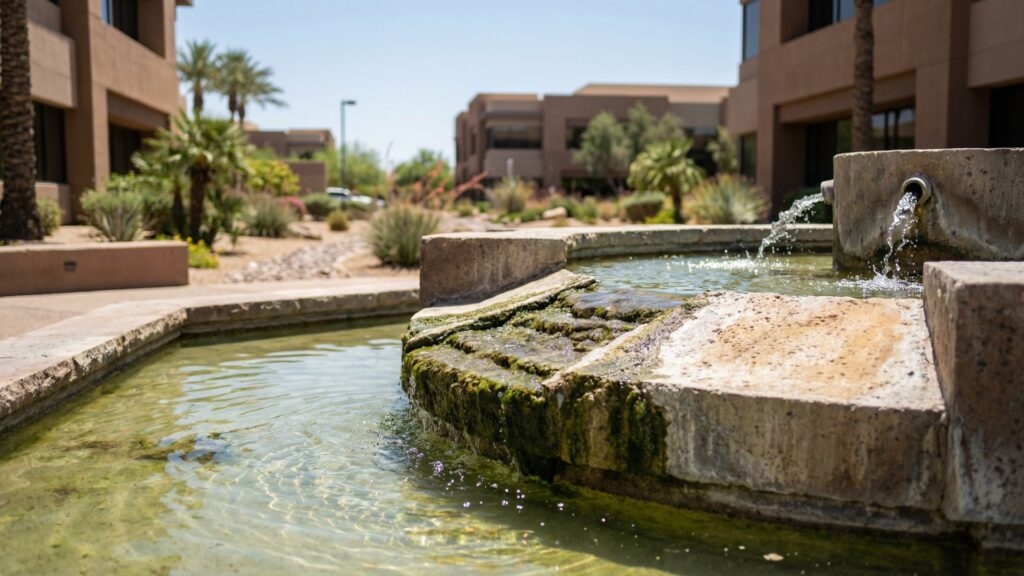
A commercial water feature in Arizona is one of the first things a visitor sees, which is why commercial water features in Arizona demand proactive care from day one. It signals to every visitor that someone invested in and cares about the property. When it’s working correctly, no one notices. When it isn’t- when the water turns green, the fountain goes silent, or the surface is covered in an algae mat everyone notices, and you’re the one fielding the calls.
What many commercial property managers don’t realize is that the visible condition of a water feature isn’t just an aesthetic issue. It’s a direct indicator of how your vendor manages the system beneath the surface. The top layer tells you whether they’re documenting, diagnosing, and maintaining proactively or simply showing up, treating what they can see, and moving on.
What the Surface Is Actually Telling You
A fountain that runs inconsistently, a lake with recurring algae, a water feature that looks fine in January but deteriorates every summer these are not random events. They are patterns. And patterns are data.
Here’s what most vendors miss: they treat each visible problem as an isolated incident. For example, the algae bloom in May gets an algaecide application; the fountain pump that fails in August gets replaced; the water clarity issue in September gets a chemical adjustment. Vendors handle each visit independently, with no thread connecting observations over time.
What that approach misses is the system. Algae blooms in May are rarely caused by something that happened in May. They are the result of nutrient loading that built up over winter, aeration equipment that was underperforming through spring, and reclaimed water chemistry that was never properly tracked or adjusted. The fountain pump that failed in August did not fail overnight; it showed signs of stress for weeks before it stopped working.
As a result, a vendor who is not documenting across visits cannot see those patterns. And a vendor who cannot see patterns cannot prevent failures.
Why Commercial Water Features in Arizona Face Greater System Risk
Commercial water features in Arizona operate under conditions that accelerate every system stress. Specifically, reclaimed water, which supplies the majority of HOA and commercial lakes in the Phoenix metro area, carries elevated nitrogen, phosphorus, and total dissolved solids. As summer heat drives evaporation, salinity concentrates in the water column, compounding the baseline nutrient load with every replenishment cycle.
When temperatures climb into the mid-to-upper 80s and beyond, which happens in Arizona by April or May and persists through September, algae growth rates accelerate sharply. Warm water holds less dissolved oxygen. Aeration systems that were adequate in March may be insufficient by June. Chemical treatment protocols calibrated for spring conditions may be completely wrong by July.
Furthermore, the monsoon season adds another layer. Heavy storms flush sediment and organic material into water features, spiking nutrient loads at the exact moment water temperatures are already at their peak. That combination elevated nutrients, high temperatures, reduced oxygen, and sediment influx is the environment where system failures compound quickly.
Equipment stress follows the same pattern. Arizona’s heat, scaling from hard reclaimed water, dust accumulation, and monsoon debris accelerate wear on pumps, compressors, and filtration systems faster than most markets. A vendor who is not tracking equipment performance over time is not catching the early signs of degradation. They are waiting for the failure.
This is where the hidden cost lives. Not in the single emergency repair, but in the accumulated deferred maintenance that made it inevitable.
What Accountability Actually Looks Like
A vendor managing a commercial water feature to a professional standard produces documentation. Not a brief service note but a record that shows water chemistry readings over time, equipment performance observations, early warning flags, and recommendations made and either acted on or declined.
That documentation serves multiple purposes. It gives you a clear picture of system health across visits. It allows your vendor to identify trends before they become problems. In addition, it gives you something concrete to present when a board member, asset manager, or ownership group asks why a line item increased or why a repair was necessary.
No one wants to defend that line item at a board meeting without being able to explain what the money was for and what it prevented. Documentation is how you do that.
We diagnose systems, not symptoms. Every visit produces data: water quality readings, equipment performance checks, early warning observations, and we track all of it over time. When something shifts, we see it in the numbers before it shows up in the water.
A Real-World Example
When we took over management of a commercial water feature portfolio in the East Valley, the previous vendor had been servicing the properties for several years. The water features looked acceptable most of the time, but the client had experienced recurring algae issues every summer and two pump failures in the prior 18 months, each requiring emergency replacement for $6,000 to $9,000 per event.
Our initial diagnostic found no documentation trail from the previous vendor, aeration equipment operating below rated capacity at two of the three properties, and water chemistry that had been drifting outside acceptable ranges for an extended period. The pump failures were not random. They were the predictable result of equipment running under stress in conditions the previous vendor never properly tracked.
Within one season under a structured management program with documented baselines, calibrated treatment protocols, and regular equipment performance checks, the client had zero emergency repairs and no significant algae events through the summer peak.
The Cost of Fragmented Vendor Accountability
When a commercial water feature is managed reactively, the costs are predictable. Emergency algaecide treatments run $3,000 to $8,000 per event. Unplanned pump replacements range from $6,000 to $15,000 depending on system size. Deferred aeration repairs that compound into full system replacements can exceed $20,000. Moreover, none of those figures account for the staff time spent managing vendor calls, coordinating emergency access, or preparing explanations for ownership.
Beyond the direct costs, there is the reputational exposure. A commercial property with a visibly degraded water feature communicates something to tenants, residents, and visitors, and what it communicates is not favorable. For a property manager overseeing a portfolio, one poorly managed water feature can affect how the entire property is perceived.
In contrast, a management program built on documentation and proactive maintenance prevents the cost spiral entirely. Maintenance should be the floor, not the ceiling.
What to Expect From a Vendor Managing to a Professional Standard
If your current vendor cannot provide a documented service history showing water chemistry trends, equipment performance observations, and written recommendations over time, that is a gap worth addressing before summer arrives.
Therefore, the April-May window is the highest-leverage period in Arizona for getting commercial water features in Arizona into a stable, well-documented baseline before heat and monsoon season create the conditions where reactive management becomes expensive.
A full-system assessment, biological and mechanical evaluated together, gives you a clear picture of what each water feature is carrying into summer and what the equipment is capable of handling. That information drives decisions. It tells you whether treatment protocols need adjustment, whether equipment needs service before it fails, and whether your current vendor is managing the system or just responding to it.
That is the difference between a vendor who documents and a program that prevents.
Lake Maintenance Service provides full-system lake management for commercial water features in Arizona and HOA properties across Maricopa County and the Phoenix metro area as part of our 360 Water Management System: One Team. One Accountability. One Plan.
We are Department of Agriculture-certified, ROC-certified, and a Women-Owned Small Business with 30-plus recurring clients across the Phoenix metro area.
waterandlakes.com | Serving Maricopa County and Arizona
Making Water Beautiful