
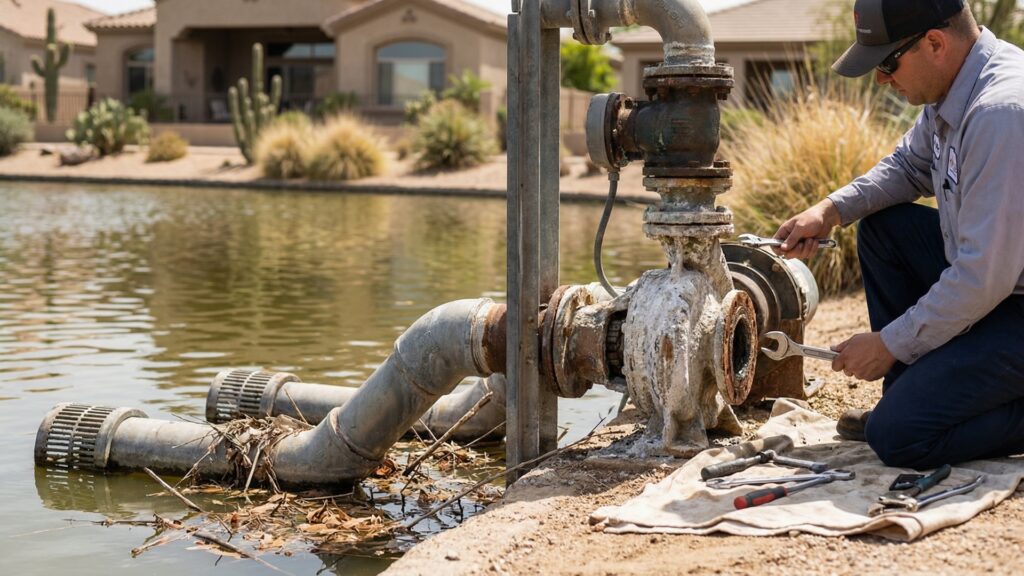
The Hidden Cost of Pump Misdiagnosis in HOA Lake Systems
When a circulation pump fails at an HOA lake, the pressure to resolve it quickly is real. Residents notice. The board asks questions. The property manager needs an answer. In that environment, many vendors default to replacement. Not because it is always right, but because it is the fastest answer.
In fact, the problem is that replacement is frequently not the right solution. As a result, the cost of that misdiagnosis falls entirely on the community.
Understanding how HOA lake pump repair in Arizona is diagnosed is critical. It helps property managers and boards protect their capital budget.
What Most Vendors Miss
The standard vendor response to a pump performance issue follows a predictable pattern. The vendor visually inspects the pump and observes output to be reduced or absent, and the vendor recommends replacement. Vendors rarely perform a systematic diagnostic. That diagnostic should distinguish between a failed pump and a repairable one.
For example, impeller wear, seal failure, and bearing degradation are all conditions that reduce pump performance and can present as pump failure, but they are also diagnosable and repairable conditions that do not require full pump replacement. Furthermore, electrical and control panel issues are another category frequently misattributed to pump failure. A pump that will not start or runs inconsistently may still be mechanically sound. The fault may be upstream entirely, in the control panel, the wiring, or the electrical supply.
A vendor without in-house repair capability has a structural incentive to recommend replacement over repair. If the only tool available is a new pump, every diagnosis tends toward that outcome. That conflict of interest is not always intentional, but communities absorbing the cost pay the price regardless.
Why HOA Lake Pump Repair in Arizona Requires Accurate Diagnosis
Arizona’s operating environment places pump systems under extreme stress. As a result, accurate diagnosis becomes critical.
Extreme heat is the most consistent factor. Pumps often run in temperatures above 100 degrees, which accelerates wear and shortens lifespan.
Reclaimed water adds another layer. It introduces minerals that create scaling on internal components, reducing efficiency over time.
Environmental Factors That Accelerate Pump Failure
A Real-World Example
A large master-planned community in the Southeast Valley experienced repeated circulation issues at one of its three HOA lakes over consecutive summers. The previous vendor had replaced the primary circulation pump twice in three years, at a combined cost exceeding $32,000. Each replacement resolved the immediate issue temporarily, but performance degraded again within one to two seasons.
When the team conducted a full diagnostic, they identified the root cause as a combination of scaling on the replacement impellers and an undersized control panel, which caused the motor to cycle irregularly under peak-load conditions. Neither issue required replacing the pump. The correct intervention was a descaling service, an impeller inspection, and a control panel upgrade. The total cost of that corrective work was under $6,000, and the system has operated without incident through two subsequent summer seasons.
Consequently, the two prior replacements had addressed the symptom without identifying the cause. The diagnostic work that should have preceded the first replacement was never performed.
The Cost of Misdiagnosis
The financial exposure from pump misdiagnosis is direct and quantifiable. A proper diagnostic and repair typically costs between $1,500 and $4,500, depending on pump type and scope. A full pump replacement for the same system ranges from $8,000 to $20,000, including equipment, labor, and system downtime.
When a vendor recommends replacement without documented diagnostic data, the community absorbs the full cost difference. Across a portfolio of lakes or a multi-year contract, that gap compounds. Communities that have experienced repeated pump replacements without resolution of the underlying performance issue are often paying for misdiagnosis repeatedly, not for equipment that has genuinely reached the end of life.
In addition, the secondary costs are less visible but equally real. Unnecessary replacements consume capital budget that could be allocated to planned infrastructure improvements. They create scheduling disruptions during peak season. And they do not resolve the root cause, meaning the next failure is already in progress.
What a Properly Managed Pump Diagnostic Program Looks Like
A professional pump diagnostic program begins before failure occurs. Pump performance data flow rates, amp draws, pressure readings, and operating temperatures should be tracked across service visits so that declining performance is identified as a trend rather than discovered as a crisis.
Therefore, the March-April window is the highest-leverage period in Arizona for pump assessment. Pre-season evaluation allows impeller condition, seal integrity, bearing wear, and electrical system performance to be assessed before summer peak demand places maximum stress on the system. Equipment that needs service or repair can be addressed during the lower-demand spring period rather than during an emergency in July.
When a performance issue is identified, the diagnostic process should be documented. The findings should distinguish between mechanical wear, electrical fault, scaling, and end-of-life failure. That documentation gives property managers and boards the information they need to evaluate recommendations, compare costs, and make defensible decisions. It also creates a record that supports capital planning and vendor accountability over time.
More than 75 percent of HOA lake pump repair cases assessed by Lake Maintenance Service are resolved in-house, which eliminates the financial incentive to recommend replacement when repair is the appropriate solution.
That is the difference between a vendor who sells equipment and a partner who protects your infrastructure.
Lake Maintenance Service provides full-system lake and water feature management for HOA and commercial properties across Maricopa County and the Phoenix metro area as part of our 360 Water Management System: One Team. One Accountability. One Plan.
We are Department of Agriculture-certified, ROC-certified, and a Women-Owned Small Business with 30-plus recurring clients across the Phoenix metro area.
waterandlakes.com | Serving Maricopa County and Arizona
Making Water Beautiful