
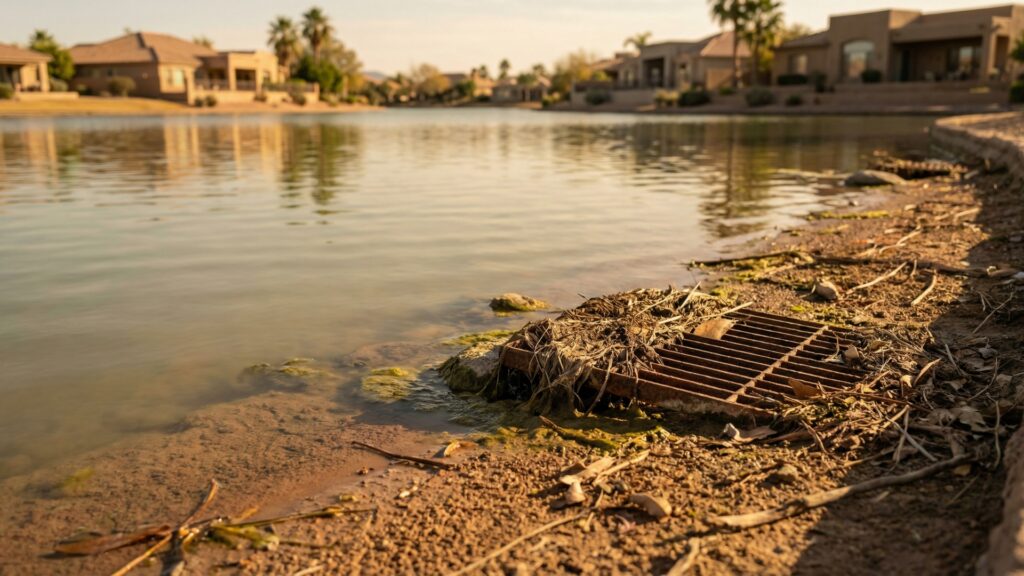
How Sediment Accumulation Silently Drains Your Lake Budget
Most HOA boards and property managers think of sediment as a cosmetic issue. However, the lake sediment management that Arizona communities rely on is not about appearance; it is about protecting system performance and avoiding long-term costs. The lake looks a little shallower than it used to. The water near the shoreline is murky after a storm. The fountain intake seems to clog more often. These observations get noted and sometimes discussed, yet action is often deferred because the system still appears to function.
That deferral is where the real cost begins. In fact, sediment is not a cosmetic problem; it is a biological, mechanical, and financial one. Effective lake sediment management in Arizona starts with understanding what sediment actually does to a system. Organic material on the lake floor degrades water quality and increases chemical demand. It also stresses mechanical equipment and drives future capital costs far beyond proactive management. As a result, by the time sediment becomes impossible to ignore, the remediation cost is no longer a maintenance line item; it is a capital project.
Why Lake Sediment Management Arizona Requires a System Approach
The standard approach to sediment in the lake management industry is to treat it as a long-term inevitability rather than an active management variable. Vendors note that sediment is present, acknowledge that dredging will eventually be needed, and move on. Most vendors do not track accumulation rates. They lack baseline depth mapping and fail to connect sediment levels to water quality and equipment performance issues.
What that approach misses is the relationship between sediment and every other system cost. Lake sediment management in Arizona is not just about depth. It is about the biological chain reactions that sediment triggers. Sediment does not sit passively on the lake floor. It decomposes. That decomposition process consumes dissolved oxygen, compounding the aeration stress that Arizona lakes already face during summer. It releases nutrients back into the water column, creating an internal loading source that continues feeding algae growth even after surface chemical treatments are applied. Furthermore, as sediment accumulates in wet wells and intake structures, it creates mechanical resistance that accelerates wear on pumps and filtration equipment.
A vendor who is not tracking sediment depth and accumulation rates over time cannot connect those dots. The vendor treats the algae bloom. They service the pump. The chemical budget increases. Consequently, the sediment that is driving all of it continues to build unaddressed.
Why Arizona Makes This More Aggressive
Arizona’s lake environment accelerates the need for proactive lake sediment management in Arizona more than most markets. Monsoon season runs from mid-June through September. During this time, storms push large volumes of sediment, debris, and nutrient runoff into lakes. A single significant monsoon event can deposit more material into a lake than months of normal inflow. That material settles to the bottom, adds to the existing organic layer, and begins decomposing in water temperatures that are already at their seasonal peak.
Reclaimed water compounds the problem. The majority of HOA and commercial lakes in the Phoenix metro area are supplied by reclaimed water, which carries elevated phosphorus levels. Phosphorus binds to sediment particles and accumulates on the lake floor. This creates an internal nutrient reservoir that surface treatments cannot fully address. Even a well-managed water chemistry program cannot fully counteract internal phosphorus loading from a sediment layer that has been building for years.
Moreover, extreme heat accelerates decomposition. The organic material that settles after a monsoon event breaks down faster in Arizona’s summer water temperatures than it would in a cooler climate. That accelerated decomposition increases biological oxygen demand at the exact time of year when dissolved oxygen levels are already at their lowest, creating the conditions where algae blooms and fish stress events are most likely to occur.
A Real-World Example
A master-planned community in the West Valley with three HOA lakes had been under routine maintenance management for several years. Teams treated water quality reactively. They applied chemicals only after algae appeared and serviced mechanical systems only when issues arose. Sediment had never been formally assessed.
When a full-system diagnostic was conducted, sediment depth mapping revealed accumulation levels that were restricting wet well capacity and contributing to repeated pump intake blockages. The internal phosphorus load from years of reclaimed water sediment buildup was identified as the primary driver of the community’s recurring summer algae problems – problems the vendor had addressed with escalating chemical applications without ever resolving the underlying cause.
The remediation scope included wet well cleanout, partial dredging of the most affected lake, and a recalibrated treatment program targeting internal nutrient loading. The total project cost exceeded $85,000. For example, a sediment assessment conducted two years earlier, at a fraction of that cost, would have identified the accumulation trend and allowed for a phased management approach that prevented the capital expenditure.
The Cost of Inaction
The financial exposure from unmanaged sediment is substantial and predictable. Wet well sediment accumulation alone can represent $40,000 or more in deferred maintenance and labor once the system reaches a critical threshold. Full dredging projects range from $50,000 to $250,000 or more depending on lake size, sediment volume, and access conditions. Lakes with unmanaged sediment require 20 to 35 percent more chemical treatment annually. Surface applications must fight a constant internal release of phosphorus and nitrogen.
In addition, those figures do not account for the secondary costs: accelerated equipment wear from sediment-laden intake water, increased aeration demand from oxygen-depleting decomposition, and the staff time spent managing reactive treatment cycles that never fully resolve the underlying problem.
A sediment depth assessment gives you a low-cost diagnostic baseline. It identifies accumulation rates and gives decision-makers the documentation needed to plan proactively and justify expenditures to boards and ownership groups before a crisis forces the conversation.
What Proper Lake Sediment Management in Arizona Actually Looks Like
A professional lake sediment management program in Arizona begins with baseline depth mapping. Depth measurements across the lake floor, wet well inspection, and intake assessment establish the current accumulation profile and provide a reference point for tracking change over time. That documentation is what allows a management team to distinguish between normal accumulation and accelerating buildup that warrants intervention.
Therefore, the October to November window is the highest-leverage period in Arizona for sediment assessment and planning. Fall conditions create the ideal environment for depth mapping and system evaluation. Water temperatures drop, biology stabilizes, and the monsoon season ends. Planning conducted in the fall allows for any necessary remediation or mechanical work to be completed before the next monsoon season resets the accumulation cycle.
Ongoing tracking through annual or biannual assessments gives boards and property managers the trend data needed to make informed capital planning decisions, to budget accurately, and to present a defensible record of proactive stewardship to ownership groups and community members.
That is the difference between managing a lake and protecting a community asset.
Lake Maintenance Service provides full-system lake and water feature management for HOA and commercial properties across Maricopa County and the Phoenix metro area as part of our 360 Water Management System: One Team. One Accountability. One Plan.
We are Department of Agriculture-certified, ROC-certified, and a Women-Owned Small Business with 30-plus recurring clients across the Phoenix metro area.
waterandlakes.com | Serving Maricopa County and Arizona
Making Water Beautiful