
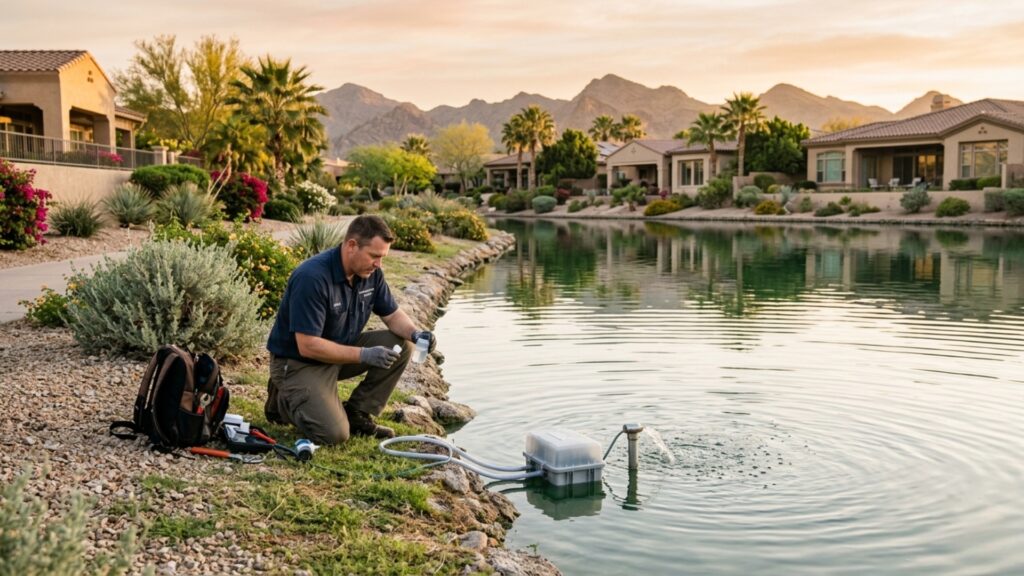
Spring Is Coming: How to Get Your Arizona Lake Ready Before Algae Season Hits
In Arizona, summer does not ease in gradually. By May, water temperatures in shallow HOA lakes can climb into ranges that accelerate algae growth, deplete dissolved oxygen, and push mechanical systems to their limits. The communities that manage summer well are almost always the ones that use March and April to prepare for spring Arizona lake maintenance.
Spring Arizona lake maintenance is not a seasonal nicety. It is the most cost-effective investment a board or property manager can make in the performance and stability of their lake system for the next six months.
Why March and April Are the Critical Window for Spring Arizona Lake Maintenance
Arizona lake systems face a compressed seasonal transition. Unlike northern climates, where spring unfolds over several months, the Phoenix metro moves from mild winter conditions to high-stress summer conditions in a matter of weeks. Water temperatures that sit in the 60s in February can reach the mid-80s by late May.
That transition is when biological and mechanical vulnerabilities become acute. Algae populations that were suppressed by cooler temperatures begin accelerating. Aeration systems that were running at reduced demand face sudden peak loads. Nutrient levels that accumulated through winter runoff and reclaimed water inputs become fuel for bloom events.
That is why spring Arizona lake maintenance completed before May gives management teams the ability to address those vulnerabilities before they become emergencies. After May, the options narrow and the costs increase.
Biological Conditions to Address Before Summer
Spring water quality benchmarks provide the baseline that determines how a lake will perform under summer stress. Before May, the following parameters should be within stable ranges:
- Total phosphorus below 0.05 mg/L in non-reclaimed water lakes; below 0.08 mg/L in reclaimed water systems
- Dissolved oxygen above 7 mg/L at the surface and above 5 mg/L in the lower water column
- pH stable between 7.5 and 8.5, with no upward drift indicating early algae activity
- Alkalinity and hardness within ranges appropriate for the water source, with treatment programs calibrated accordingly
- Chlorophyll a at baseline levels with no trend indicating accumulating biomass
Reclaimed water inputs carry elevated nitrogen and phosphorus year-round. Winter runoff adds additional nutrient loads from surrounding landscaping and hardscape. Spring is the time to assess those accumulated loads and adjust treatment programs before warm temperatures activate them.
Aeration System Readiness: A Spring Priority
Aeration is the single most important mechanical defense against summer algae and low dissolved oxygen events. It is also the system most likely to fail under peak summer demand if it has not been inspected and serviced in the spring.
A thorough lake system inspection in Arizona in March or April should include:
- Compressor performance verification under load, not just visual inspection
- Diffuser inspection and cleaning to confirm output is reaching the water column effectively
- Airline integrity check for cracks, blockages, or pressure loss
- Cabinet and electrical component review for heat-related wear before ambient temperatures climb
- Documentation of baseline output to compare against mid-summer performance
An aeration system that is running at 80 percent capacity in April will not improve under the stress of a 110-degree July. Spring is the time to identify and correct performance deficits before they contribute to a fish kill or bloom event.
Sediment and Wet Well Conditions to Inspect Each Spring
Winter months bring reduced maintenance intensity and, in Arizona, monsoon season residue that settles through the fall. By spring, sediment accumulation in wet wells and intake structures can be significant enough to affect pump performance and water circulation.
Spring diagnostics should include a wet well inspection to assess sediment depth, intake screen condition, and any signs of biological growth or structural wear. Even a few inches of sediment in a wet well can reduce pump efficiency, increase energy consumption, and accelerate wear on impellers and seals. Addressing those conditions now avoids the compounding effect of running degraded equipment through the highest-demand months of the year.
The Cost of Skipping Spring Arizona Lake Maintenance
Arizona lake algae prevention is substantially less expensive than algae treatment. A reactive summer management approach typically involves emergency chemical applications, expedited service calls, and, in some cases, fish mortality events that require restocking and community communication.
The cost differential is significant. Emergency algae treatment for a mid-sized HOA lake can run two to four times the cost of a proactive spring treatment program. Pump repairs or replacements that result from deferred spring servicing add further unplanned expense. The disruption to residents and the reputational exposure for board members and property managers compound the financial impact.
Spring Arizona Lake Maintenance Checklist for HOA Boards
Before May, confirm the following with your lake management provider:
- Water quality baseline documented with current parameter readings
- Nutrient management program adjusted for spring inputs and summer risk
- Aeration system inspected, cleaned, and performance-verified
- Wet well and intake structures inspected and cleared of sediment
- Equipment service records updated, and any deferred repairs scheduled
- Reporting format confirmed to include early warning flags for summer threshold parameters
- Emergency response protocol reviewed, and contact information is current
Schedule a Spring Arizona Lake Maintenance Assessment
Maricopa County lake care programs that perform well through summer are built on spring preparation. Lake Maintenance Service works with HOA boards, property managers, and commercial asset managers across the Phoenix metro area to complete full spring system assessments before the algae season window closes.
Our 360 Degree Water Management System covers biological water quality and mechanical infrastructure together: One Team. One Accountability. One Plan. We do not separate water chemistry from equipment performance, because the two are directly connected.
We are Department of Agriculture-certified, ROC-certified, and a Women-Owned Small Business with 30-plus recurring clients across Maricopa County.
waterandlakes.com | Serving Maricopa County and Arizona
Making Water Beautiful