
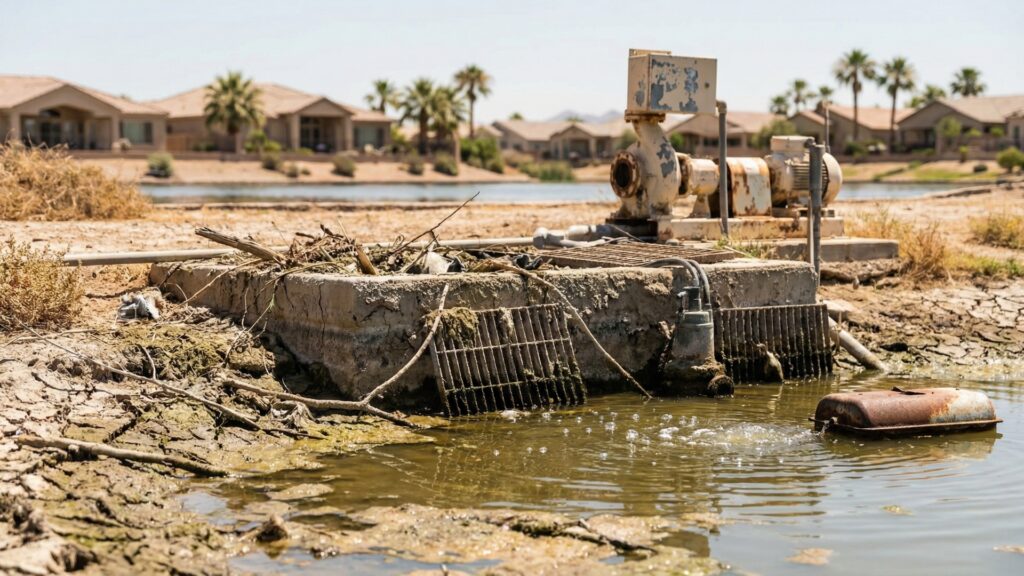
The Hidden Cost of Deferred Maintenance in Lake Systems
Lake maintenance costs in Arizona often rise because of decisions that don’t initially feel financial. When a wet well cleaning gets pushed to the next quarter, the cost doesn’t disappear. Delaying pump service until failure signs show up increases risk. Skipping diffuser inspections allows hidden issues to build. The expense simply moves forward and compounds.
A $4,000 maintenance item can turn into a $40,000 corrective project. Deferred maintenance in lake systems isn’t a budget strategy; it’s a cost transfer that rarely favors the property.
Understanding how lake maintenance costs in Arizona compound is the starting point for making informed budget decisions. Understanding this requires clarity on how lake systems fail, and why the conditions that make Arizona lake management uniquely demanding also make the cost of deferral uniquely high.
What Most Vendors Miss
Most lake management programs are structured around scheduled service visits, not proactive risk documentation. A vendor may visit monthly, apply chemicals, and file reports. That fulfills a service contract. Most vendors do not systematically identify or communicate deferred maintenance risks in a way that gives property managers and municipal directors the information they need to make informed budget decisions.
The result is a visibility gap. A property manager cannot plan without sediment data. Without it, proactive budgeting becomes impossible. A municipal director who has not received documentation that a pump is drawing elevated current has no reason to authorize a service intervention before the unit fails. Without that documentation, the board never makes a true deferral decision; costs accumulate regardless of inaction.
Furthermore, vendors who do not proactively document deferred maintenance risks ensure those conversations happen later, under worse conditions, with larger numbers attached.
How Lake Maintenance Costs in Arizona Compound When Items Are Deferred
Deferred maintenance does not create isolated problems. It creates cascading failures. Each deferred item increases cost and complexity. Lake systems are fully integrated: biological balance depends on mechanical performance, mechanical performance depends on infrastructure condition, and infrastructure condition depends on routine maintenance that keeps sediment, scaling, and wear within manageable thresholds.
Specifically, sediment accumulation in wet wells and intake structures is one of the clearest examples of this pattern. A wet well cleaned on a routine schedule costs $3,000 to $5,000 per service cycle. A neglected wet well can require $40,000 or more in corrective work. By that point, routine maintenance is no longer enough. The sediment did not become more expensive to remove because of inflation. It became more expensive because deferral allowed it to reach a threshold where routine maintenance was no longer sufficient.
Pump servicing follows the same logic. A pump that receives regular inspection and proactive servicing remains in service longer and performs within its design parameters. A deferred pump often requires full replacement. This costs $10,000 to $20,000 per unit, when proactive servicing would have extended its service life at a fraction of that cost. Moreover, aeration system neglect compounds the biological side: diffuser fouling and compressor wear reduce oxygen transfer efficiency, which increases algae pressure, which increases chemical costs by 20 to 35 percent annually, which accelerates the biological deterioration that makes every other maintenance task harder and more expensive.
A lake system that has deferred multiple maintenance items simultaneously is not in a stable state. It is in a pre-failure state. The triggering event, whether a monsoon, a heat spike, or a pump failure, is a matter of timing, not probability.
Why Arizona Accelerates the Cost of Deferral
In a temperate climate, a deferred maintenance item may remain within a manageable range for an extended period before it crosses into corrective territory. In Arizona, that window is compressed by conditions that have no equivalent in most of the country.
Summer temperatures exceeding 110 degrees Fahrenheit accelerate equipment wear, scaling, and biological pressure simultaneously. Reclaimed water chemistry, with total dissolved solids commonly ranging from 800 to 1,500 mg/L, deposits mineral scale on pump impellers, diffuser membranes, and filtration components at rates that freshwater systems do not experience. Evaporation concentrates nutrients and salinity over time. This increases biological demand as oxygen capacity drops.
Arizona’s operating environment compresses the timeline between deferred items and corrective events, making lake maintenance costs in Arizona compound faster than most markets. Each factor increases cost. Together, they accelerate system failure.
A Real-World Example
A municipal parks department in the West Valley managed two reclaimed water lakes in a public park under a service contract that covered routine chemical applications and monthly visits. Budget constraints led to the deferral of wet well cleaning for two consecutive years and the postponement of a flagged pump service on the primary circulation unit.
In the third year, the primary pump failed during peak summer. The wet well had not been cleaned in 26 months. Sediment buildup restricted intake flow and contributed to pump failure. Emergency pump replacement cost $16,500. Wet well corrective cleaning and intake repair totaled $43,000. Emergency chemical treatment during the two weeks of reduced circulation added $6,200. Consequently, total unplanned expenditure for that single failure sequence exceeded $65,000.
The routine maintenance that had been deferred over those two years would cost approximately $11,000 in total. The decision to defer $11,000 in scheduled lake maintenance costs in Arizona produced a $65,000 corrective event, plus the staff time, public communication, and reputational exposure that accompanied a visible failure in a public park.
The Cost of Inaction
Proactive maintenance programs typically cost 15 to 25 percent more annually than reactive programs. Over five years, they deliver 40 to 60 percent lower total cost of ownership because they prevent the compounding corrective expenditures that reactive programs absorb. Proactive programs reduce lake maintenance costs in Arizona by 40 to 60 percent over five years compared to reactive approaches. The math is not complicated. The challenge is visibility. Proactive costs appear in this year’s budget. The savings show up later under different line items.
In addition, full-system diagnostics that identify and document deferred maintenance risks before they become failures give decision-makers the information they need to make that calculation accurately before a crisis forces it. Therefore, without that documentation, the compounding cost of deferral remains invisible until it is no longer avoidable.
That is the difference between a maintenance budget and a failure budget.
Lake Maintenance Service provides full-system lake and water feature management for HOA and commercial properties across Maricopa County and the Phoenix metro area as part of our 360 Water Management System: One Team. One Accountability. One Plan.
We are Department of Agriculture-certified, ROC-certified, and a Women-Owned Small Business with 30-plus recurring clients across the Phoenix metro area.
waterandlakes.com | Serving Maricopa County and Arizona
Making Water Beautiful