
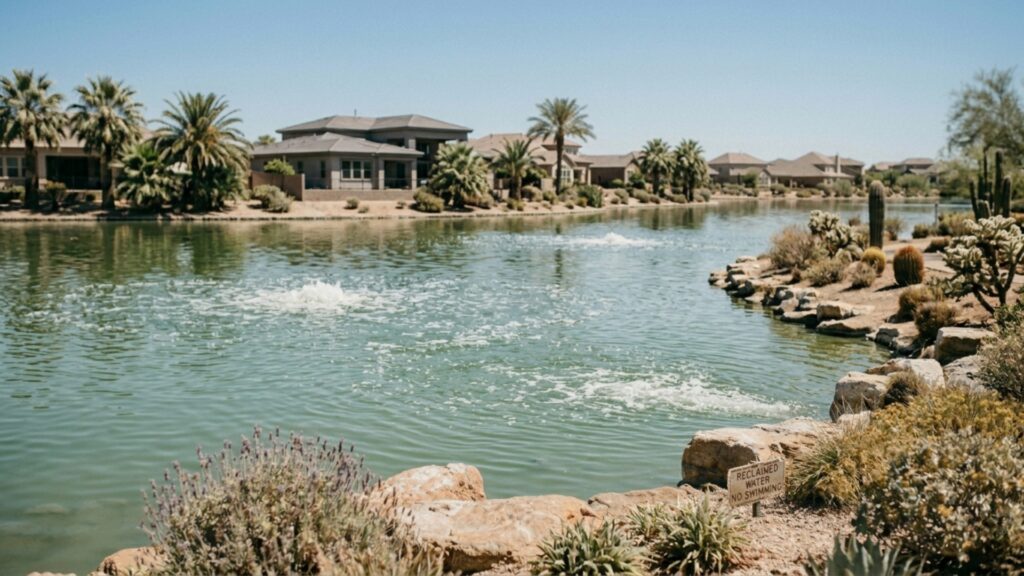
How Reclaimed Water Affects Your Arizona HOA Lake
(And What to Do About It)
If your HOA lake is fed by reclaimed water, it is not the same as a freshwater lake. It behaves differently, responds to different treatments, and is far less forgiving of management gaps. Recognizing these differences is the foundation of HOA lake water quality management in Arizona.
Reclaimed water supplies most HOA and master-planned community lake systems across Maricopa County because it’s cost-effective and reliable in a water-scarce environment. But its chemical complexity creates real challenges when those differences aren’t factored into lake water quality management in Arizona.
What Reclaimed Water Is and Why It Is So Widely Used
Reclaimed water is highly treated municipal wastewater that has been processed to a level safe for non-potable uses, including landscape irrigation, golf courses, and decorative lake systems. In the Phoenix metro area, it is distributed through a separate purple-pipe infrastructure and is a cornerstone of Arizona’s water reuse strategy.
For HOAs and master-planned communities, reclaimed water is often the only practical and cost-effective option for maintaining lake levels given Arizona’s climate and water allocation constraints. That makes understanding its characteristics not optional, but essential for anyone responsible for Maricopa County lake care.
The Biological Challenges Reclaimed Water Creates
Reclaimed water carries a chemical profile that is fundamentally different from freshwater. The most significant biological challenges it introduces are the following.
Elevated Nitrogen and Phosphorus
Reclaimed water consistently carries higher concentrations of nitrogen and phosphorus than freshwater sources. These nutrients are the primary fuel for algae and cyanobacteria growth. In a lake system that receives reclaimed water year-round, nutrient loading is continuous, not seasonal.
High Total Dissolved Solids and Salinity Buildup
Reclaimed water has elevated TDS levels, and in Arizona’s climate, evaporation concentrates those solids further over time. Salinity accumulation creates water chemistry conditions that favor certain harmful organisms, including golden algae (Prymnesium parvum), which thrives in higher-salinity environments and can cause rapid, lethal fish kills.
Accelerated Algae and Cyanobacteria Bloom Pressure
The combination of elevated nutrients, high TDS, and Arizona’s intense solar exposure creates conditions where bloom development can occur faster and more aggressively than in comparable freshwater systems. Lake algae prevention in reclaimed water systems requires a higher baseline of management activity, not just reactive treatment when blooms become visible.
Fluctuating Water Quality Inputs
Reclaimed water quality is not static. Seasonal variation in municipal treatment outputs, changes in source water, and shifts in community water use patterns can all affect the nutrient and chemical profile of what enters your lake. A management program that does not track these inputs over time cannot accurately anticipate bloom pressure or calibrate treatment programs.
The Mechanical Challenges Reclaimed Water Creates
The biological risks of reclaimed water are well documented. The mechanical risks are less frequently discussed but equally significant for Arizona lake maintenance.
Scaling on Pumps and Equipment
The elevated mineral content in reclaimed water accelerates calcium and magnesium scaling on pump impellers, diffuser membranes, and pipe interiors. Scaling reduces hydraulic efficiency, increases energy consumption, and shortens equipment service life.
Diffuser Fouling
Aeration diffusers in reclaimed water systems foul more rapidly than those in freshwater systems. Fouled diffusers reduce oxygen transfer efficiency, which directly undermines the aeration system’s ability to suppress algae development and maintain dissolved oxygen levels for fish and aquatic life.
Accelerated Corrosion
The chemical composition of reclaimed water is more corrosive to metal components than freshwater. Electrical connections, control panels, pump housings, and intake hardware in reclaimed water systems require more frequent inspection and maintenance to stay ahead of corrosion-related failures.
Reduced Treatment Efficiency
Hard water chemistry interferes with the effectiveness of common algaecides and water quality treatments. A chemical program designed for freshwater will underperform in a reclaimed water system if dosing and product selection are not adjusted to account for the water’s actual chemistry.
Why Reclaimed Water Lakes Require a Different Management Approach
The core issue is this: a management program designed for a freshwater lake will systematically underperform in a reclaimed water system. The nutrient loads are higher, the equipment stress is greater, and the bloom triggers are more sensitive.
Applying generic lake management practices to a reclaimed water system is not a neutral decision. It is a decision to accept higher chemical costs, more frequent equipment failures, and greater bloom risk.
Effective reclaimed water lake management in Arizona requires a program built around the specific chemistry and mechanical demands of that system, updated regularly as inputs change.
What Proactive Reclaimed Water Management Looks Like in Practice
A well-managed reclaimed water lake system in Maricopa County will have the following in place on an ongoing basis:
- Baseline water chemistry testing that tracks nitrogen, phosphorus, TDS, salinity, pH, dissolved oxygen, and alkalinity over time
- Nutrient trend analysis that identifies directional changes in loading before they translate into bloom pressure
- Aeration system calibration verified against actual dissolved oxygen readings across all lake zones, not just compressor output specs.
- Diffuser inspection and cleaning on a schedule appropriate to the reclaimed water inputs, not a generic freshwater timeline
- Chemical program adjustments that account for hard water chemistry and actual nutrient concentrations
- Equipment inspection protocols that prioritize scaling, corrosion, and fouling as primary wear mechanisms
This is what reclaimed water lake management in Arizona looks like when it is done correctly. It is data-driven, system-specific, and updated continuously as conditions change.
Schedule a Reclaimed Water System Assessment
Lake Maintenance Service provides full-system assessments for HOA and commercial lake systems across Maricopa County and the Phoenix metro area, with specific expertise in reclaimed water lake management that Arizona communities depend on year-round.
Our 360° Water Management System evaluates biological water quality and mechanical infrastructure together because, in a reclaimed water system, the two dimensions are inseparable. We are Department of Agriculture-certified, ROC-certified, and a Women-Owned Small Business serving 30-plus recurring clients across the Phoenix metro area.
waterandlakes.com | Serving Maricopa County and Arizona
Making Water Beautiful