
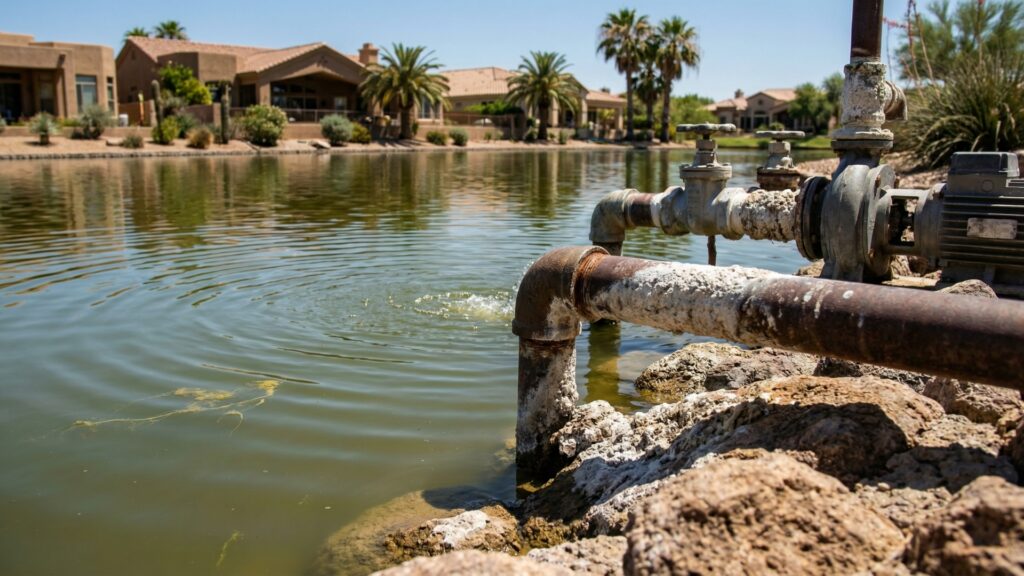
Why Reclaimed Water Lakes Require a Different Management Approach
A reclaimed water lake in Arizona is not a standard lake. It is a different biological and chemical system. Treating it like a standard lake is one of the most common and costly mistakes HOA boards make in Arizona lake management. The water carries a chemical profile that changes algae growth, equipment wear, treatment performance, and problem timing. A freshwater management program accounts for none of that. In Arizona’s climate, those consequences compound quickly. Most boards underestimate how fast this happens.
Understanding why reclaimed water requires a different approach begins with understanding what reclaimed water actually is, and what it does to a lake system over time.
What Most Vendors Miss
Most lake management vendors apply a standardized service protocol across their entire client base. Vendors set visit frequency, chemical rates, and maintenance schedules using general industry norms, not the specific chemistry of the water source. For freshwater lakes, that approach is often adequate. For reclaimed water lakes, it is structurally insufficient.
The gap is not always visible in the first season. For example, a reclaimed water lake in Arizona managed with a freshwater protocol will appear functional for a period, particularly if conditions are mild. Problems develop beneath the surface. Nutrient loads accumulate, scaling increases, and biological pressure builds faster than the program can handle. By the time the consequences are visible, the system has already been operating in a deficit for months.
A vendor who does not differentiate between freshwater and reclaimed water management is not making a minor technical oversight. They are applying the wrong framework to a system that operates by different rules. Furthermore, the property pays for that misalignment, not the vendor.
Why Reclaimed Water Lake Chemistry in Arizona Demands a Different Protocol
Specifically, reclaimed water in Arizona typically carries total dissolved solids of 800 to 1,500 mg/L, compared to 200 to 500 mg/L in typical freshwater sources. That difference is not cosmetic. High TDS increases calcium, magnesium, and sodium levels. These minerals scale onto pumps, diffusers, and filtration components. Scaling reduces efficiency and shortens equipment life. It also creates a maintenance burden that freshwater programs cannot manage.
The nutrient profile is equally consequential. Reclaimed water carries elevated concentrations of nitrogen and phosphorus, the primary drivers of algae and cyanobacteria growth. In a freshwater lake, those nutrients are present at levels that a standard chemical program can manage. In a reclaimed water lake, they exist at levels that requirechemistry-specific treatment protocols and more frequent monitoring to prevent bloom development.
Arizona’s climate intensifies both of these challenges. Summer temperatures exceeding 110 degrees Fahrenheit drive evaporation at rates that concentrate TDS, nutrients, and salinity in the water column over time. A reclaimed water lake becomes more aggressive over time. By July, evaporation has concentrated everything in the water. A management program that ignores that seasonal concentration effect does not manage the system; it reacts to it.
Moreover, dual-use reclaimed water lakes those that serve both aesthetic and irrigation functions face an additional layer of nutrient loading from the surrounding landscape. Fertilizer residue, organic debris, and runoff from irrigated turf and hardscape return to the lake through surface drainage and irrigation interfaces, compounding the nutrient load that the water source is already delivering. Managing a dual-use reclaimed water lake requires an understanding of the entire nutrient cycle, not just the water chemistry at the point of fill.
A Real-World Example
A commercial property in Scottsdale with two reclaimed water lakes had managed lake services under a standard contract for four years. The program covered routine chemical applications and monthly service visits using the same treatment protocols applied across the vendor’s freshwater client base. Reclaimed water chemistry: the management scope did not include reclaimed water chemistry.
By the third summer, both lakes were experiencing recurring cyanobacteria blooms that required emergency chemical intervention. Cyanobacteria, commonly called blue-green algae, carries public health implications that standard algae blooms do not, including the potential for toxin production that can affect people and animals in contact with the water. The property posted advisory signage during two separate bloom events, generating resident complaints and management escalations.
A full-system assessment followed. It showed fouled diffuser membranes and inefficient pump impellers. The chemical program also delivered 30-40% less effective treatment due to high TDS. Consequently, corrective mechanical work and a full program redesign totaled just over $29,000, not including the cost of the emergency chemical treatments, the staff time spent managing the bloom events, or the reputational exposure from the public health advisories.
The Cost of the Wrong Protocol
The financial exposure from managing a reclaimed water lake in Arizona with a freshwater protocol follows a predictable pattern. An incorrectly calibrated program requires 30 to 50 percent more chemicals. It compensates for the mismatch instead of solving the root issue. That overspend accumulates quietly across every service cycle.
Mechanical costs follow the same pattern. Scaling from high TDS is not a gradual inconvenience. It is an active degradation process that shortens the service life of pumps, diffusers, and filtration components on a timeline that is significantly compressed compared to freshwater systems. Equipment that lasts 8-10 years in freshwater may fail in 4-6 years in reclaimed water systems.
In addition, cyanobacteria risk adds a third cost dimension that is difficult to quantify but impossible to ignore. A bloom event in a community amenity lake is not just a water quality problem. It is a liability event, a communication problem, and a reputational risk for every decision-maker associated with the property.
What a Reclaimed-Water-Specific Program Looks Like
A management program designed for a reclaimed water lake in Arizona begins with a chemistry baseline that documents TDS, nutrient levels, pH, alkalinity, and hardness at the start of the program and tracks those parameters across seasons. That baseline is the reference point for every treatment decision, every equipment inspection, and every adjustment made as Arizona’s summer heat concentrates the water column.
From that baseline, the program applies chemistry-specific treatment protocols calibrated for the buffering capacity and nutrient load of reclaimed water, not freshwater averages. Mechanical maintenance schedules account for the accelerated scaling and fouling rates that high-TDS water creates. Therefore, monitoring frequency increases during peak summer months, when evaporation-driven concentration is highest, and cyanobacteria pressure is most acute.
That is the difference between a lake that is managed and one that is managed for the water it actually contains.
Lake Maintenance Service provides full-system lake and water feature management for HOA and commercial properties across Maricopa County and the Phoenix metro area as part of our 360 Water Management System: One Team. One Accountability. One Plan.
We are Department of Agriculture certified, ROC certified, and a Women-Owned Small Business with 30-plus recurring clients across the Phoenix metro area.
If your property uses reclaimed water and your lake management program no one has specifically designed it for that chemistry, contact us at waterandlakes.com to schedule a full-system assessment.
Making Water Beautiful.