
What Aeration Actually Does And Why Most Systems Are Undersized
Lake aeration systems in Arizona are among the most misunderstood parts of lake management. Many vendors treat aeration as an amenity, a visual feature that adds movement and appeal to the water’s surface. That framing isn’t just incomplete; it’s operationally risky. Aeration is the primary mechanism for maintaining dissolved oxygen, and without it, the biological balance that keeps a lake healthy begins to collapse.
Algae take over. Fish populations become stressed and die. Chemical costs climb. The visible deterioration that follows isn’t just a water quality issue; it’s an infrastructure failure that often begins with lake aeration systems in Arizona that were never properly sized or maintained.
Understanding what aeration actually does, and what happens when it’s insufficient, is the starting point for managing any lake system responsibly.
What Most Vendors Miss
Most vendors install aeration systems based on surface area and depth. Then they treat them as fixed infrastructure with minimal ongoing attention. That approach has two significant gaps.
The first is sizing. Vendors design most aeration systems for average operating conditions, not peak demand. For example, in a temperate climate, average and peak conditions are close enough that the gap rarely causes problems. In Arizona, they are not. A system sized for average demand in a moderate climate becomes undersized in Arizona summers. The gap creates predictable failures.
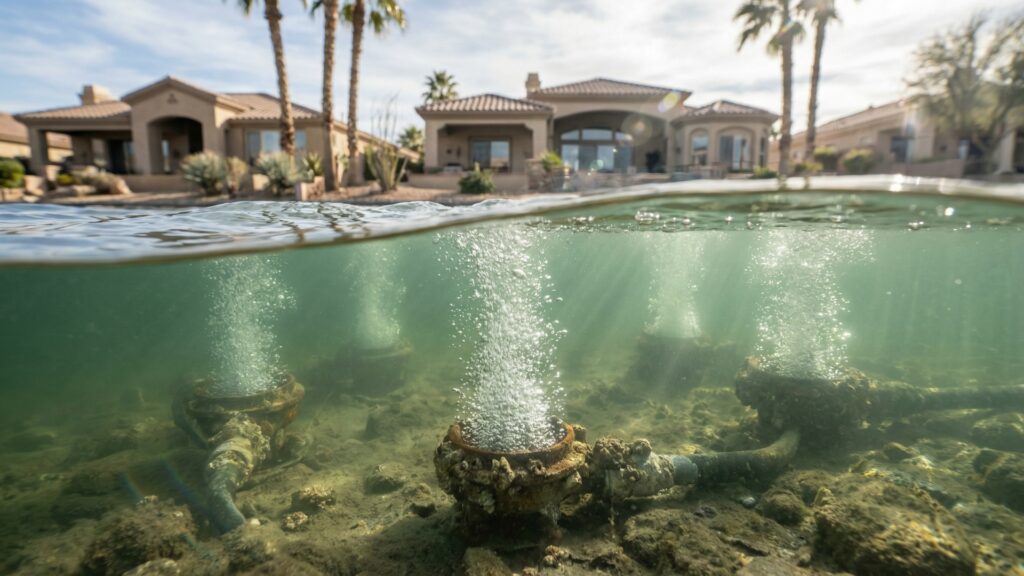
The second gap is maintenance. Aeration compressors, whether rotary vane, rocking piston, or linear diaphragm units ranging from 0.25 to 10-plus horsepower, require regular inspection and servicing to maintain output efficiency. Diffusers, the components that transfer oxygen from the compressor into the water column, foul easily in Arizona’s reclaimed water environment. Furthermore, a vendor who does not include diffuser inspection and cleaning as a standard component of the management program leaves one of the most consequential variables in the system unmonitored.
The gap between a functioning aeration system and a failing one is rarely visible until the system can no longer keep pace with biological demand. By that point, the damage is already developing.
Why Lake Aeration Systems in Arizona Are Pushed Beyond Their Design Limits
Arizona’s operating environment places demands on lake aeration systems in Arizona that standard sizing guidelines do not account for, and those demands compound across multiple variables simultaneously.
Water temperatures in Arizona lake systems regularly reach 85 to 95 degrees Fahrenheit or higher during peak summer months. Warm water holds less dissolved oxygen than cool water. As a result, biological oxygen demand peaks when oxygen capacity is lowest. A system operating at its design limit in spring is already undersized by July.
Reclaimed water chemistry adds a second layer of pressure. Arizona reclaimed water lakes carry significantly higher concentrations of nitrogen and phosphorus than freshwater systems. Those elevated nutrient loads drive higher biological oxygen demand year-round, not just during summer peaks. Specifically, an aeration system that might be adequate for a freshwater lake of the same size is structurally insufficient for a reclaimed water lake in the same location.
Diffuser fouling caused by mineral deposits in reclaimed water is a third factor that vendors consistently underdiagnose. High dissolved solids create scaling on diffuser surfaces over time. This can reduce oxygen transfer efficiency by 30 to 50 percent. A compressor running at full output through a fouled diffuser array does not deliver full output to the water column. It is compensating for a maintenance deficit that is invisible without direct inspection.
Moreover, the monsoon season introduces a final variable. The organic debris delivered by storm runoff begins decomposing immediately in warm water, consuming dissolved oxygen in the process. An aeration system at capacity has no buffer. It cannot absorb additional oxygen demand during monsoon events. The result is a rapid drop in dissolved oxygen at the moment when the lake system is least equipped to recover.
A Real-World Example
A municipal park in the West Valley, managing a single reclaimed water lake of approximately four surface acres, had operated with the same aeration system for six years. The system team sized the system at installation based on surface area and average depth. Diffuser inspection was not part of the annual maintenance scope.
In August of the sixth year, a significant monsoon event delivered heavy organic debris into the lake. Within 72 hours, dissolved oxygen levels dropped below the critical threshold, fish stress became visible, and a partial fish kill followed. Emergency response required supplemental aeration equipment, emergency chemical treatment, and additional labor over a five-day stabilization period.
Consequently, total emergency expenditure for that single event exceeded $11,000. A full-system assessment followed. It showed the diffuser array had lost about 40 percent efficiency due to scaling. The system had operated below oxygen thresholds for at least two seasons. This was caused by a system that had been quietly failing for years.
The Cost of Undersized or Neglected Aeration
When dissolved oxygen in a lake system drops below 4 mg/L, the threshold below which fish stress and algae dominance accelerate, the consequences are not gradual. They are rapid and expensive. Emergency response to a fish kill typically costs $5,000 to $15,000. This includes chemicals, supplemental aeration, and labor.
In addition, a properly maintained and correctly sized lake aeration system in Arizona can reduce algae-related chemical costs by 20 to 35 percent annually. That reduction is not a marginal benefit. Over the life of a lake management contract, it represents a meaningful offset against the cost of the aeration program itself.
What a Properly Designed Aeration Program Looks Like
A proper aeration program starts with sizing for peak demand. It does not rely on average conditions. That evaluation considers water temperature at peak summer, nutrient load from the water source, lake volume and depth profile, and the biological oxygen demand that the system must sustain through the highest-stress period of the year.
Therefore, the program includes regular compressor performance monitoring, diffuser inspection and cleaning on a schedule appropriate for the reclaimed water environment, and oxygen transfer efficiency tracking to identify deviations before they become failures. When a compressor is losing output or a diffuser array is fouling, the data exists to intervene before dissolved oxygen drops to a critical level.
Aeration is not a set-and-forget component. It is a dynamic system that requires active management to perform at the level a lake system depends on. A vendor who treats it otherwise is not managing the system. They are monitoring it until something goes wrong.
That is the difference between an aeration system that supports a lake and one that is simply running.
Lake Maintenance Service provides full-system lake and water feature management for HOA and commercial properties across Maricopa County and the Phoenix metro area as part of our 360 Water Management System: One Team. One Accountability. One Plan.
We are Department of Agriculture-certified, ROC-certified, and a Women-Owned Small Business with 30-plus recurring clients across the Phoenix metro area.
waterandlakes.com | Serving Maricopa County and Arizona
Making Water Beautiful