
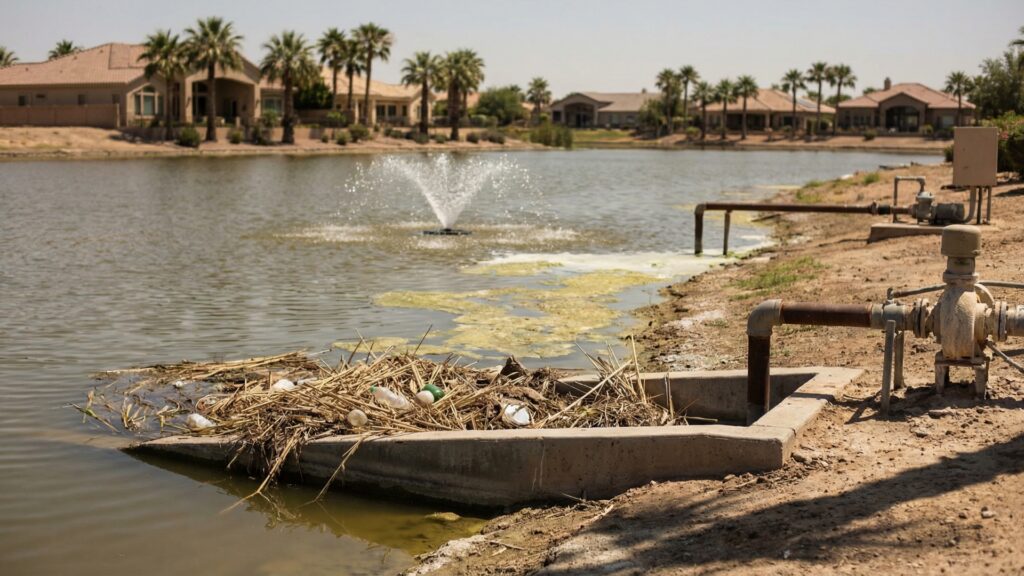
The Hidden Cost of Deferred Maintenance in Lake Systems
Most boards never frame deferred lake maintenance in Arizona as a decision. It happens gradually. Contracts prioritize low cost over full scope. Service programs address visible problems but leave underlying issues undocumented. Budget cycles treat lake management as a fixed line item instead of a system that requires active investment. By the time costs become visible, they have already compounded. At that point, they are far more expensive than the maintenance that was skipped.
In fact, deferring maintenance does not reduce cost. It transfers cost forward, with interest, in the form of emergency repairs, accelerated equipment failure, reactive chemical programs, and liability exposure that accumulates quietly until it does not.
What Most Vendors Miss
Most lake management programs are not designed to surface the true cost of deferred lake maintenance in Arizona. A vendor operating on a low-bid contract has a structural incentive. They address what is visible and billable, not what is deteriorating beneath the surface. When vendors file reports, they record what happened during a visit. They rarely record what they found or deferred. They also fail to document the likely consequences.
That documentation gap leaves decision-makers without the data they need to make informed choices. A property manager reviewing a renewal cannot evaluate system condition without baseline data. Without it, they cannot tell if the system improved or declined. Without that baseline, there is no trend data or early warning. There is also no framework to distinguish a stable system from one accumulating deferred liability.
Furthermore, the absence of documentation is not a neutral condition; it is a risk condition. When a capital failure occurs, the decision-maker is accountable for a problem that was never formally identified, tracked, or communicated. A properly structured management program makes the system condition visible, trackable, and defensible.
Why Deferred Lake Maintenance in Arizona Compounds Faster Than Anywhere Else
Arizona’s operating environment does not allow deferred lake maintenance and time to develop slowly. Extreme heat, reclaimed water chemistry, and monsoon season create compounding conditions. These factors shorten the timeline between deferred maintenance and failure.
Specifically, summer temperatures in Maricopa County regularly exceed 110 degrees Fahrenheit, placing sustained thermal stress on pump motors, seals, and bearings for months at a time. A seal may last several seasons in a moderate climate. In Arizona, it can fail within a single summer. Reclaimed water chemistry adds a second layer of acceleration. High dissolved solids and nutrient loads foul impellers and corrode seals. They also reduce hydraulic efficiency and require constant monitoring.
Moreover, monsoon season then delivers sediment, debris, and nutrient-laden runoff into systems that are already under maximum stress, compounding every existing deficiency in intake maintenance, aeration capacity, and water quality management.
In Arizona, deferred maintenance does not wait. It advances.
A Real-World Example
A mid-sized HOA in the East Valley with two reclaimed water lakes had managed lake services under a low-bid contract for three consecutive years. The contract covered chemical applications and scheduled service visits. Full-system diagnostics, pump performance documentation, and sediment assessment were not part of the scope.
At the start of the fourth year, the team conducted a full-system diagnostic as part of a contract rebid process. The assessment revealed sediment buildup in both wet wells requiring dredging. It also found a circulation pump operating below efficiency due to scaling. Aeration diffusers were fouled, and the control panel had deferred compliance issues with unknown liability exposure.
Consequently, the corrective scope totaled just over $67,000, covering wet well cleanout, pump rehabilitation, diffuser replacement, and electrical remediation even as the system had received regular service visits throughout. The visits had addressed surface-level chemical and biological management. They had not addressed the mechanical and structural deterioration accumulating underneath.
The Cost of Inaction
The financial exposure from deferred lake maintenance in Arizona follows predictable patterns. Sediment accumulation in wet wells can exceed $40,000 if left unaddressed. By the time dredging is required, costs have already escalated. Pump misdiagnosis resulting from the absence of baseline performance data leads to $10,000 to $20,000 in unnecessary replacements when a pump that could have been repaired or optimized is instead condemned based on incomplete information.
Aeration inefficiencies increase chemical costs by 15 to 30 percent. Systems compensate for reduced oxygen transfer with higher chemical input. Poor intake maintenance drives chemical budgets up by 20 to 40 percent. Algae pressure increases without mechanical support. In addition, deferred electrical compliance creates liability exposure that is difficult to quantify in advance and significantly more expensive to resolve after an incident than before one.
Over a three-to-five-year period, costs compound significantly. They often exceed the cost of proactive management.
What a Proactive Program Changes
A proactive lake management program typically costs 10 to 25 percent more than a low-bid reactive contract at the point of signing. That premium reflects a different scope. It includes diagnostics, performance baselines, mechanical oversight, in-house repair, and reporting that keeps system condition visible.
Therefore, communities that transition to proactive management programs stabilize total lake management spend within 12 to 18 months. The emergency repair line items that characterized the reactive period are replaced by planned, budgeted interventions at a fraction of the emergency cost. The unpredictability that makes lake management difficult to budget becomes manageable because the system condition is known, documented, and actively managed.
Full-system diagnostics identify deferred lake maintenance in Arizona before it becomes a capital event. That is the difference between a maintenance budget that grows every year and one that finally stabilizes.
Lake Maintenance Service provides full-system lake and water feature management for HOA and commercial properties across Maricopa County and the Phoenix metro area as part of our 360 Water Management System: One Team. One Accountability. One Plan.
We are Department of Agriculture-certified, ROC-certified, and a Women-Owned Small Business with 30-plus recurring clients across the Phoenix metro area.
waterandlakes.com | Serving Maricopa County and Arizona
Making Water Beautiful