
How Monsoon Season Changes Everything for Arizona Lake Management
Most property managers and HOA boards think of monsoon season as a weather event. It is not. In fact, for lake systems in the Phoenix metro area, monsoon lake management in Arizona is a stress test. Whether a system passes depends on what the management team does before the first storm arrives.
Arizona’s monsoon season runs from June 15 through September 30, with peak storm activity concentrated in July and August. That window overlaps with peak summer stress. During this time, lake systems operate under maximum biological and mechanical load. Water temperatures are elevated. Dissolved oxygen levels are suppressed. Algae pressure is building. Equipment is running harder than at any other point in the year. As a result, when a monsoon event hits a lake system in that condition, the consequences are not gradual. They are immediate, and they compound quickly.
What Most Vendors Miss
Most standard programs treat monsoon lake management in Arizona as a background condition rather than a distinct operational phase. Vendors continue their scheduled service cycles, respond to visible problems after storms, and address issues as they arise. Most programs do not include a defined pre-season preparation protocol, a documented baseline against which post-storm conditions can be measured, and a structured post-storm response commitment with a specific timeline.
That gap matters because the window for intervention after a significant monsoon event is narrow. Nutrient-laden runoff enters a lake system at the exact moment when biological conditions are most favorable for rapid algae growth. Without a pre-season baseline and a vendor who can be on-site promptly after a storm, the team has no decision-making framework. The vendor arrives, finds a problem already developing, and reacts to it. Consequently, the cost of that reactive response is consistently higher than the cost of the preparation that would have prevented it.
Furthermore, documentation is the foundation of a monsoon-ready program. A vendor who has not established pre-season water quality baselines, inspected and cleared intake screens, and assessed sediment levels in wet wells before the season begins is not equipped to manage what the monsoon season delivers.
What Monsoon Season Actually Does to a Lake System
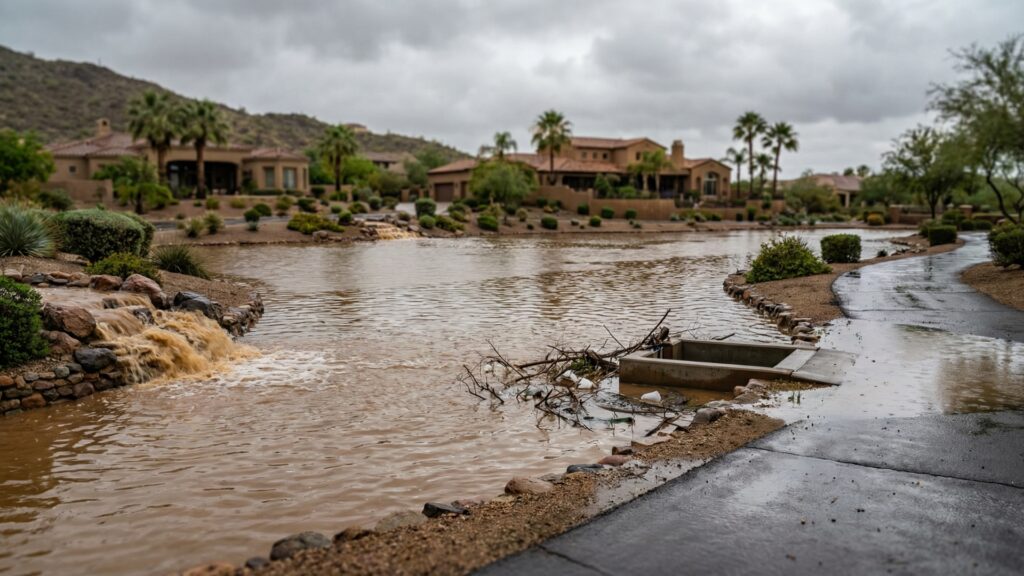
A single monsoon event can deliver one to three inches of rain in under an hour. That volume of water does not absorb gradually into the surrounding landscape. It moves across hardscape, turf, and soil. It collects sediment, debris, and nutrient runoff before entering the lake.
The biological impact is rapid. Nutrient loading from monsoon runoff can trigger algae and cyanobacteria blooms within 48 to 72 hours when water temperatures are already elevated. In a reclaimed water lake, where baseline nutrient levels are already high, a monsoon nutrient pulse can push conditions past the bloom threshold almost immediately. The heat that defines Arizona summers provides no buffer; it accelerates the process.
The mechanical impact is equally significant. Specifically, sediment buildup in wet wells and intake systems can reduce pump efficiency by 20 to 40 percent. This happens quickly if crews do not clear it. Intake screens that are partially blocked increase motor load, elevate operating temperatures, and shorten the service interval. A management program that skips post-storm intake inspection leaves that risk entirely unmanaged.
Moreover, most teams underestimate oxygen depletion as a third consequence. The organic debris delivered by monsoon runoff begins decomposing immediately in warm water, consuming dissolved oxygen in the process. Combined with the oxygen demand of an algae bloom, a single storm event can create conditions that stress or kill fish populations within days if aeration support is not adequate and responsive.
A Real-World Example
A large HOA community in the West Valley with three interconnected lakes entered monsoon season without a documented preparedness protocol. The management contract covered routine chemical applications and scheduled service visits, but The contract did not include pre-season intake inspection or post-storm response.
For example, a significant storm in late July delivered approximately two inches of rain in under 90 minutes. Runoff from the surrounding landscaped areas carried heavy sediment and fertilizer residue into all three lakes. Within three days, two of the lakes showed visible algae development. Intake screens on the primary circulation system were partially blocked, reducing pump output and elevating motor temperatures. Emergency chemical treatment was required on both affected lakes, and a service call was needed to clear the intake system and assess pump condition.
Total emergency expenditure for that single storm event exceeded $21,000, including chemical treatment, emergency labor, and a pump service call. The community had no pre-season baseline documentation, which meant the vendor had no reference point for evaluating how far conditions had deviated or how quickly the system was recovering. The response was slower and more expensive than it needed to be.
The Cost of Being Unprepared
The financial exposure from a single unprepared monsoon season is not a worst-case scenario. It is a predictable outcome. Emergency algae treatment following a monsoon event typically costs $3,000 to $8,000 per incident, and without a response protocol, communities can face $15,000 to $40,000 in seasonal costs. In addition, that figure does not include the reputational cost of visible water quality failures, resident complaints, or the staff time required to manage unplanned vendor coordination during peak summer demand.
Communities that absorb those costs are not unlucky. They went into the season unprepared. And the preparation that would have prevented most of that expenditure is not expensive or complicated. It requires a vendor who treats the monsoon season as a defined operational phase and builds the protocols to match.
What Monsoon Lake Management in Arizona Actually Requires
A properly structured monsoon lake management program in Arizona begins before the season starts. Pre-season baseline documentation establishes water quality parameters, pump performance benchmarks, and sediment levels in wet wells and intake systems. Intake screens are inspected and cleared. Aeration capacity is evaluated against the oxygen demand that peak summer conditions and monsoon nutrient loading will create together.
Therefore, the program must also include a defined post-storm response protocol with a specific timeline. A vendor who can be on-site within 24 to 48 hours of a significant storm event can assess conditions, clear intake systems, adjust chemical programs based on post-storm water quality readings, and intervene before a bloom establishes. That response window is not a preference. It is the operational threshold that separates prevention from reaction.
Monsoon lake management in Arizona is not an add-on to a lake management program. It is a core component of managing Arizona lake systems responsibly. A vendor who does not include it in the standard scope is not offering a complete program.
That is the difference between a monsoon season that tests your system and one that breaks it.
Lake Maintenance Service provides full-system lake and water feature management for HOA and commercial properties across Maricopa County and the Phoenix metro area as part of our 360 Water Management System: One Team. One Accountability. One Plan.
We are Department of Agriculture-certified, ROC-certified, and a Women-Owned Small Business with 30-plus recurring clients across the Phoenix metro area.
waterandlakes.com | Serving Maricopa County and Arizona
Making Water Beautiful